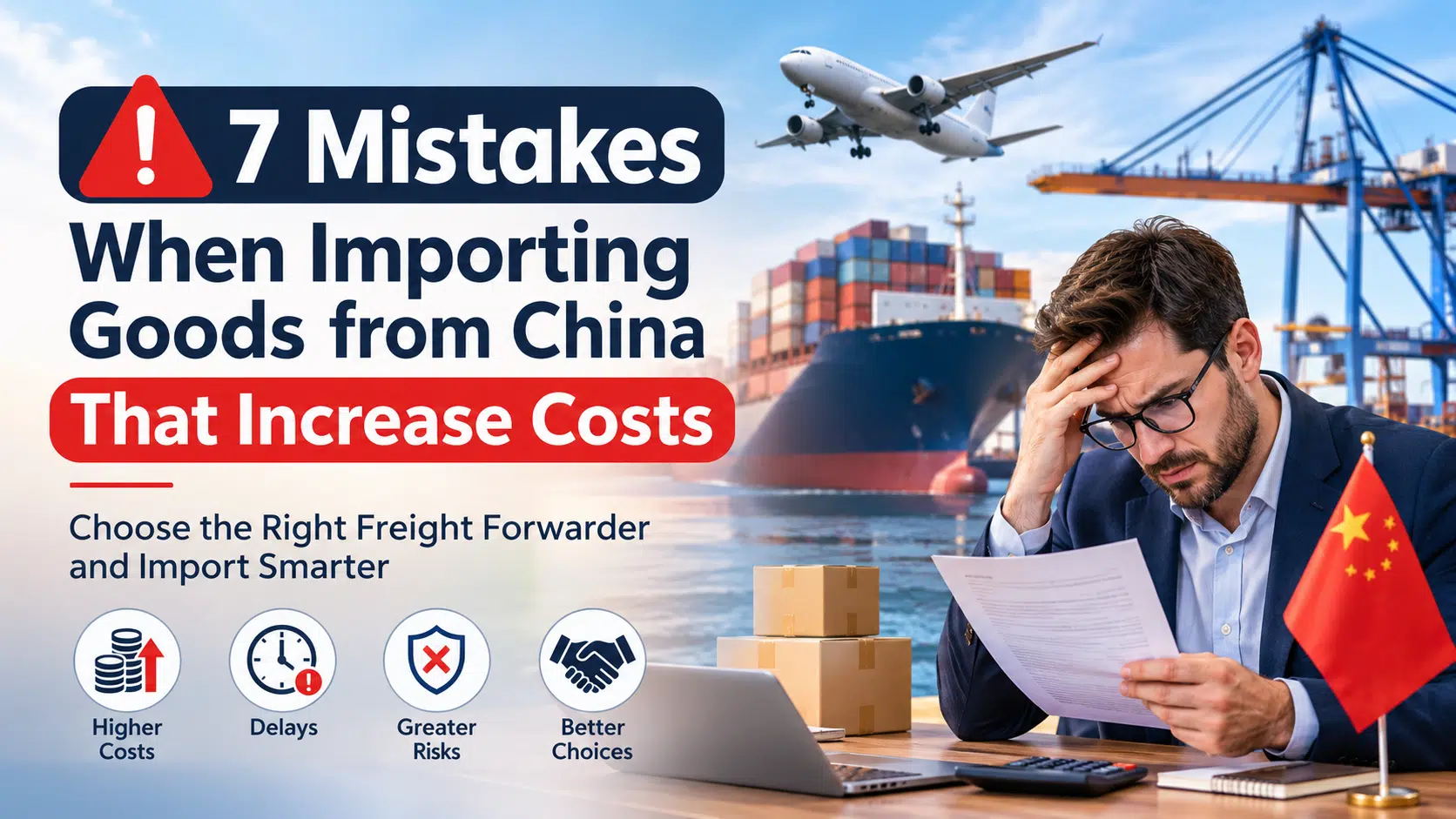
Choosing an international freight forwarding company for importing goods from China is not simply about selecting a provider to move your cargo. This decision can affect delivery times, customs costs, the risk of damage, and even your working capital.
Many importers overlook important details when comparing freight rates, such as insurance coverage, route experience, cost transparency, and the quality of shipment tracking and customer support. A professional international logistics company should be able to coordinate the entire process, from cargo collection and transportation to documentation and final delivery.
An experienced International Freight Forwarder plays an important role in reducing operational errors throughout this process. If you want to understand which mistakes can increase the cost of importing from China and how to avoid them before signing a contract, read on. This article examines the most important factors to consider when choosing a freight forwarding company.
1. Choosing a Freight Forwarding Company Based Only on the Lowest Quote
One of the most common mistakes importers make when selecting an international freight forwarding company is assuming that the lowest quote is automatically the best option. At first glance, lower freight rates may seem attractive. However, the quoted price does not always represent the final shipping cost.
Some charges, such as loading, warehousing, terminal handling, documentation, insurance, destination services, or costs resulting from delays, may not be included in the initial quotation. Therefore, when comparing different offers, you should evaluate the total cost, service quality, and contractual commitments together.
A professional International Freight Forwarder generally provides a transparent cost breakdown and explains potential additional charges. The main objective should be to find the best value for your money, rather than simply choosing the lowest initial rate.
Identify Hidden Costs
Before signing a contract, ask the freight forwarding company to provide an itemized breakdown of all transportation-related charges. Origin charges, destination charges, documentation, warehousing, and additional services should be clearly identified.
Comparing detailed quotations provides a much more accurate picture than comparing a single overall figure.
Compare the Final Shipping Cost
A company offering a lower initial rate may ultimately be more expensive if it charges higher additional fees. When choosing an international freight forwarding company, compare the final amount you will actually pay rather than focusing only on the base freight rate.
A Lower Price Does Not Always Mean Better Value
An unusually low quotation may indicate that certain services have been excluded, insurance coverage is limited, or the estimated transit time is longer.
Make sure you understand exactly which services each company provides for the quoted price.

2. Ignoring the Company’s Experience in the China Shipping Route
Importing goods from China involves several operational details, and the freight forwarding company’s experience plays an important role in managing them. One major mistake is choosing a provider that lacks sufficient experience with your particular shipping route or the type of goods you intend to import.
Different types of cargo have different requirements regarding packaging, documentation, capacity, scheduling, and handling. An experienced international logistics company generally has a better understanding of origin procedures, shipping lines, ports, departure schedules, and potential transportation challenges.
An experienced Freight Forwarder can also recommend more suitable shipping options based on your cargo’s volume, weight, value, and delivery urgency. For this reason, a company’s actual experience handling shipments from China should be one of your main evaluation criteria.
Check the Company’s Experience on the Route
The number of years a company has been operating is not enough to establish its expertise. You should find out how many shipments it has handled on the China route and whether its experience is relevant to your type of goods and purchasing requirements.
Relevant experience is more valuable than general industry experience.
Experience with Your Type of Cargo Matters
Sensitive, fragile, oversized, perishable, or high-value goods may require different shipping and handling methods.
A company with experience transporting similar products is generally better prepared to anticipate operational risks and recommend appropriate solutions.
Ask About Potential Shipping Challenges
A professional freight forwarding company should be able to explain possible challenges along the route, peak shipping periods, the likelihood of delays, and alternative solutions.
The quality of its answers can reveal more about its practical knowledge than its advertising claims.

3. Overlooking Customer Support and Communication Quality
The transportation process does not always go according to the original schedule. Departure dates may change, documents may require corrections, or shipments may experience delays.
Under these circumstances, the quality of customer support becomes particularly important.
One common mistake when choosing an international freight forwarding company is focusing too much on the sales process while paying little attention to the quality of support provided after the contract is signed.
A freight forwarding company should have clearly defined communication channels, a designated contact person, a shipment tracking system, and a consistent reporting process.
International logistics services are truly valuable when customers can receive accurate and timely information at every stage of transportation. Prompt communication helps prevent poor decisions and additional costs caused by delays.
Check the Shipment Tracking System
Importers should be able to understand the current status of their shipments and how important changes will be communicated.
A shipment tracking system or regular progress reports make it easier to monitor the transportation process and respond quickly when problems arise.
Have a Dedicated Contact Person
If you have to communicate with a different employee every time you need an update, the chances of confusion increase.
It is better for the company to assign a dedicated contact person to your shipment. This helps ensure that information and communication records are managed consistently.
Evaluate Response Times Before Signing the Contract
One simple way to evaluate customer support is to observe how quickly and accurately the company responds during the negotiation stage.
If responses are incomplete or significantly delayed before the contract is signed, you should not expect better communication when an actual problem occurs.

4. Neglecting Insurance Coverage and the Company’s Liability for Damage
Goods purchased from China may face various risks during transportation, including physical damage, loss, moisture exposure, breakage, or other shipping-related incidents.
However, some importers assume that using a freight forwarding company’s services automatically means that all potential losses are fully covered.
In reality, insurance conditions and the freight forwarding company’s liability must be examined separately.
A reputable International Freight Forwarder should clearly explain the scope of its liability, insurance conditions, coverage limits, and applicable exclusions.
When selecting an international freight forwarding company, consider the actual value of your goods and their level of transportation risk.
Review the Type of Insurance Coverage
Cargo insurance should be selected according to the nature and value of the goods being transported.
Before shipment, review the covered risks, exclusions, compensation limits, and deductibles. Do not assume that every type of damage or loss is automatically covered.
Define Responsibilities in the Contract
The contract should clearly specify each party’s responsibilities in the event of damage, loss, or delays.
If these responsibilities remain unclear, disputes are more likely to arise when something goes wrong, and the claims process may take considerably longer.
Declare the Actual Value of Your Goods
Understating the declared value of goods to reduce certain costs may create problems when filing an insurance claim.
Cargo information should be accurate and reflect the actual value of the goods. This helps prevent unnecessary complications during the investigation and compensation process if an incident occurs.

5. Failing to Check Shipping Documents and Cargo Details Carefully
Documentation is not simply an administrative part of importing goods from China. Any inconsistency between shipping documents and the actual cargo can result in delays, document corrections, and additional costs.
The weight, number of packages, product specifications, buyer and seller information, and invoice details must all be checked carefully.
A professional international logistics company should have a clear process for verifying shipment information and identifying potential discrepancies before the cargo departs.
One of the important responsibilities of an experienced Freight Forwarder is coordinating shipping information among the different parties involved.
When selecting an international freight forwarding company, make sure to ask at which stage documents are checked and who is responsible for final approval.
Review Documents Before Loading
It is better to verify the main shipping documents before cargo loading begins.
Checking the commercial invoice, packing list, number of packages, weight, and product specifications can help identify simple but costly mistakes before transportation starts.
Ensure All Documents Contain Consistent Information
If product descriptions, quantities, or weights differ between documents, the likelihood of complications increases.
Using an internal checklist to cross-check information can prevent many avoidable discrepancies.
Define Who Is Responsible for Verifying Information
It should be clear who is responsible for approving the final shipment information.
The freight forwarding company can identify visible errors and discrepancies, but the importer must also review and approve the commercial information and product specifications.
6. Choosing a Shipping Method Without Considering Delivery Time and Cargo Value
Another mistake that can increase import costs is selecting a shipping method without evaluating the actual needs of the business.
Some importers always look for the cheapest transportation option, even though longer transit times can tie up their capital for an extended period.
On the other hand, choosing a faster shipping method for goods that are not time-sensitive can also create unnecessary expenses.
International transportation should be planned based on the cargo’s value, volume, weight, required delivery time, profit margin, and the cost of tied-up capital.
A good International Freight Forwarder should offer several shipping options and explain the advantages and limitations of each one.
Effective international logistics services involve choosing a transportation method that creates the right balance between cost, time, and risk.
Calculate the Cost of Tied-Up Capital
When a shipment spends a long time in transit, your investment remains tied up for a longer period.
Therefore, when comparing shipping methods, do not consider freight charges alone. Also calculate how delivery time may affect your cash flow and sales schedule.
Match Shipping Speed to Order Urgency
Seasonal products or orders that must reach the market by a specific date have greater time sensitivity.
In these situations, paying more for a faster shipping method may be more economical than dealing with the financial consequences of a delayed delivery.
Request Different Shipping Options
A professional freight forwarding company should not recommend only one transportation method without first evaluating your requirements.
Requesting several shipping scenarios allows you to compare costs, delivery times, and risks before making an informed decision.
7. Failing to Have a Clear Contract and Verify the Company’s Credibility
Even if a freight forwarding company offers competitive rates, has relevant experience, and provides good customer support, the absence of a clear contract can create problems later.
One of the most important mistakes when choosing an international freight forwarding company is relying on verbal promises without documenting the company’s commitments.
The contract should specify the agreed services, costs, estimated delivery schedule, payment terms, liability for damage, dispute resolution procedures, and conditions under which the shipping plan may change.
The company’s credibility should also be verified before entering into a business relationship.
International logistics services are reliable when the provider has a clear organizational structure, a verifiable track record, and well-defined contractual obligations.
Carefully reviewing the contract and checking the company’s credibility can significantly reduce the risks associated with making a rushed decision.
Put All Commitments in Writing
Promises regarding delivery times, service types, and final costs should be documented in the contract.
Relying on scattered messages or verbal agreements can make it more difficult to establish responsibilities if a dispute occurs.
Check the Company’s Track Record
Having a professional website is not enough to establish a company’s credibility.
Review its business history, customer experiences, years of operation, communication practices, and ability to manage unexpected problems.
A company’s actual credibility should be supported by verifiable evidence.
Read the Important Contract Clauses
Before signing, carefully review the clauses covering additional charges, delays, damage, service cancellations, and route changes.
If any clause is unclear, ask the company to explain it or provide a more precise version.

How to Calculate the Actual Cost of Importing Before Choosing a Freight Forwarding Company
As you may already know, one of the best ways to prevent rising import costs is to prepare a complete estimate of potential expenses before signing a contract.
Importers should not consider only the main freight charge.
Packaging, loading, origin services, main transportation, insurance, warehousing, destination services, and potential delay-related expenses should all be included in a comprehensive cost calculation.
This approach helps distinguish between the advertised price and the actual cost of importing goods.
A professional international logistics company should be able to categorize the charges and explain which costs may change under specific circumstances.
When selecting an international freight forwarding company, it is also advisable to obtain written quotations from several providers.
These quotations should be compared under exactly the same conditions. Comparing shipping rates for services with different levels of coverage and support can lead to misleading conclusions.
Do Not Separate Freight Charges from the Total Import Cost
Freight charges represent only one part of the total import cost.
If additional expenses are not included in the initial calculations, the final landed cost of the goods may differ significantly from the original estimate, reducing your expected profit margin.
Set Aside a Budget for Potential Additional Costs
When preparing your financial plan, it is advisable to allocate part of your budget to unexpected expenses.
The goal is not to predict every possible future event, but to ensure that the financial impact of delays and unexpected changes remains manageable.
Compare Quotations Under Equal Conditions
When comparing several freight forwarding companies, provide each one with the same information, including cargo type, volume, weight, origin, destination, required delivery time, and insurance coverage.
Otherwise, differences in price may result from differences in the services offered rather than the actual superiority of one company over another.

Why Service Quality Matters More Than the Initial Freight Rate
At first glance, the freight rate may seem like the most important factor when choosing a shipping provider.
However, within a real supply chain, the quality of service execution can have a much greater impact on the final cost.
Delays, documentation errors, poor communication, or unsuitable shipping routes can create expenses that are several times greater than the initial difference between two freight quotations.
For this reason, choosing an international freight forwarding company should involve a combination of factors, including price, experience, credibility, and service quality.
A professional Freight Forwarder does more than simply transport cargo. It also plays an important coordinating role between suppliers, carriers, warehouses, documentation teams, and other parties involved in the supply chain.
The better this coordination, the lower the likelihood of operational errors and repeated work.
Therefore, importers should view a freight forwarding company not simply as an expense, but as an important part of supply chain and risk management.
Evaluate Service Quality Using Specific Criteria
To compare service quality, consider measurable factors such as response times, pricing transparency, shipment tracking capabilities, route experience, documentation accuracy, and the company’s approach to handling damage claims.
Using clear evaluation criteria makes the decision more objective and less dependent on personal impressions.
Compare Sales Promises with Actual Performance
During negotiations, companies may promise a wide range of services.
Ask them to explain how these services are actually delivered. Examples of previous experience and documented procedures can help establish whether their promises are realistic.
Consider Service Quality Alongside Price
If two companies offer similar rates but one provides more comprehensive services and stronger customer support, choosing the higher-quality provider may be more economical in the long run.
The cost of preventing a major shipping mistake can sometimes be significantly higher than the difference between two freight quotations.

A Simple Checklist for Comparing Freight Forwarding Companies
To make a better decision when choosing an international freight forwarding company, compare several providers using a simple table or evaluation sheet before making your final choice.
Important criteria include:
- Company name
- Base freight rate
- Additional charges
- Estimated transit time
- Available shipping methods
- Insurance coverage
- Shipment tracking availability
- Experience with the China shipping route
- Contract terms and conditions
- Quality of customer support
This approach helps ensure that your decision is not based solely on a phone conversation or an attractive quotation.
It is also useful to ask each company specific questions, such as:
- What happens if the shipment is delayed?
- How are warehousing charges calculated?
- Who is responsible for checking the shipping documents?
- What risks does the insurance policy cover?
- What is the procedure if goods are damaged during transportation?
The answers to these questions can reveal the difference between a professional service provider and a less experienced alternative.
An international logistics company is a suitable choice when it can provide clear, documented, and reliable answers.
Ultimately, your decision should be based on a combination of evaluation criteria rather than a single feature.
Evaluate Rates, Transit Time, and Services Together
None of these three factors is sufficient on its own.
A low freight rate combined with an excessively long transit time or poor service quality can increase the actual cost of importing.
Your objective should be to find the right balance between all three.
Include Risk in Your Final Decision
One company may charge slightly more but have greater experience with your shipping route and a better ability to reduce operational risks.
This difference should be considered part of the value of its services rather than simply an additional expense.
Conclusion
Importing goods from China can be financially successful when hidden costs, operational risks, and transportation service quality are managed from the beginning.
Choosing an international freight forwarding company should never be based solely on price. Instead, importers should evaluate several factors, including route experience, cost transparency, customer support, insurance coverage, document verification, shipping methods, and company credibility.
A professional International Freight Forwarder can simplify coordination between different stages of the transportation process and reduce the likelihood of costly mistakes.
Likewise, reliable international logistics services should give importers better control over their shipments and associated costs.
The most important point is to compare quotations under identical conditions and obtain all commitments in writing before signing a contract.
Making the right decision at this stage can help prevent significant additional expenses later in the import process.
Frequently Asked Questions (FAQs)
1. Is choosing an international freight forwarding company based only on the lowest price a good decision?
No. The lowest initial quotation does not necessarily mean the lowest final cost. Importers should also evaluate additional charges, insurance coverage, and service quality before making a decision.
2. Does a freight forwarding company’s experience with the China shipping route matter?
Yes. Relevant experience with the China shipping route and the specific type of cargo helps a freight forwarding company anticipate potential challenges and manage them more effectively.
3. Can checking shipping documents help prevent higher import costs?
Yes. Carefully reviewing shipment information before departure can help prevent documentation discrepancies, transportation delays, and unnecessary additional expenses.